There’s a subtler caution, too. Forcing a collaborative approach onto teams and workflows built for a different way of working can add friction and forfeit the benefits. Where alignment is missing, a method like PDB can’t compensate for it.
The skill, then, lies in matching the method to the drivers and risk profile of each project, and in being honest about which one a given organization is ready to execute.
Clearing up some collaborative project delivery myths
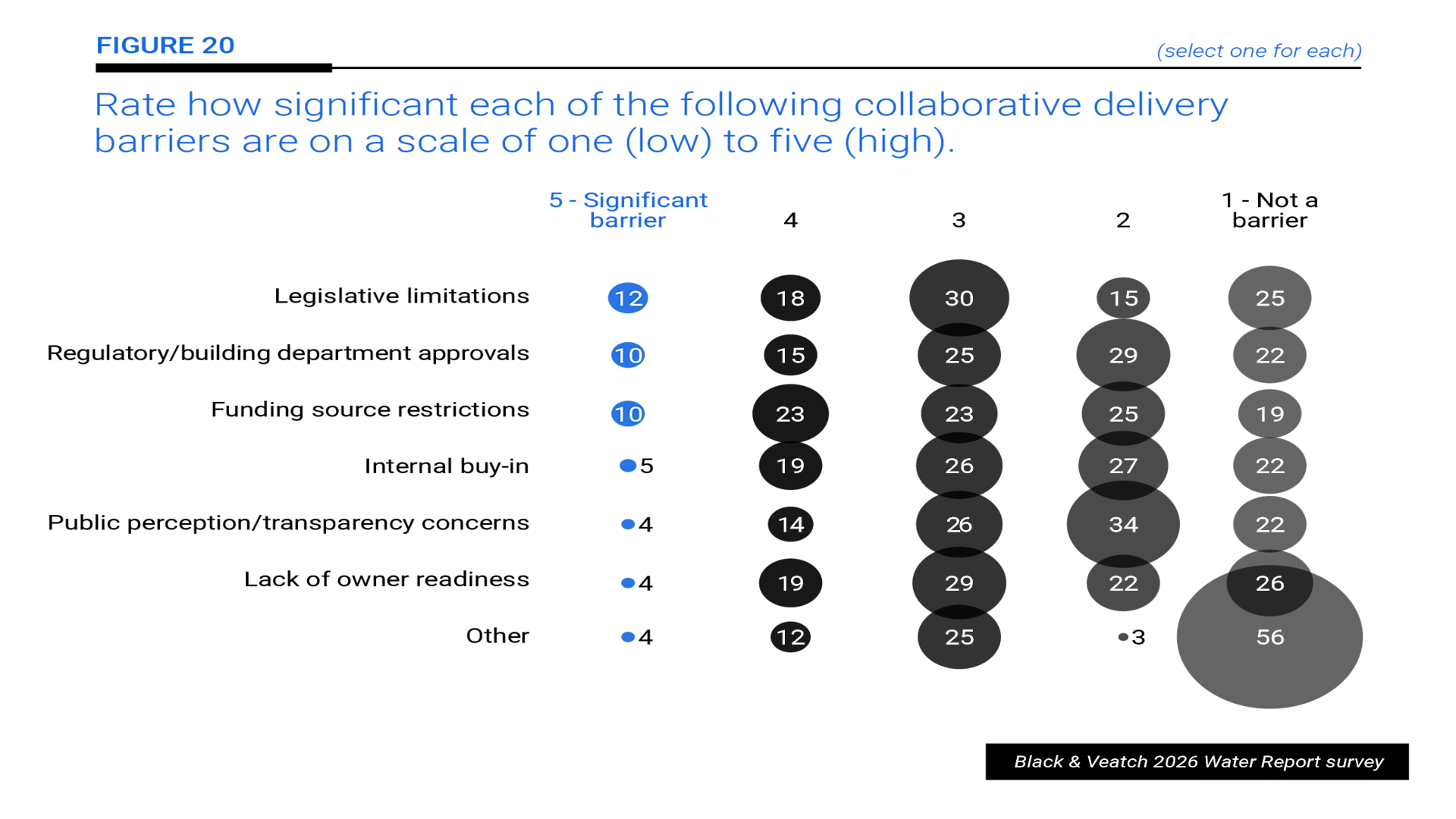
Ask why more utilities don’t use collaborative project delivery and you’ll often hear that funding sources won’t allow it. In many cases, that’s a misconception. Most major funding sources now permit design-build and other collaborative approaches. The genuine constraint is the amount of funding available. Rules about how it can be used are rarely the obstacle.
The distinction matters because the two problems call for different responses. A funding shortfall is a capital-planning challenge. A perceived restriction that doesn’t really exist is an information problem, one that keeps utilities from an approach they’re entitled to use. Clearing up that misunderstanding is one of the fastest, lowest-cost ways to expand the options on the table.
The same is true of legislative barriers. Where they persist, they often trace back to advocacy by specific interest groups more than to any settled judgment about what works best. And the trend points toward fewer barriers over time, as states continue to open collaborative delivery to a wider range of projects and communities.
Design-build project proof point: Morro Bay
On California’s central coast, Morro Bay faced a state mandate to replace a 60-year-old, flood-vulnerable wastewater plant — the largest, most complex and most expensive project in the city’s history — on an urgent, regulatory-driven schedule.
Delivering the new Water Resources Center under a best-value design-build contract let the team confront the biggest cost and performance risks early, while the design was still taking shape. During guaranteed maximum price (GMP) development, the team replaced a traditional flow-equalization basin with a primary-filtration and stormwater adaptive filtration (SAFE) strategy, saving more than $7 million in construction costs. Those savings were reinvested into a membrane bioreactor upgrade that produced a smaller footprint and cleaner effluent and yielded California’s first mainline wastewater plant to pair MBR treatment with indirect potable reuse. The facility now produces a million gallons a day of purified water to recharge the local groundwater basin.
Just as important, early collaboration helped the city absorb real-world disruptions — site and environmental delays, pandemic-related impacts, cultural-resource discoveries and evolving permitting — while staying on track to meet the regulatory deadline. That is the practical advantage of bringing construction and operations input into design and procurement. When conditions change, the team can adjust quickly and to keep the project on target.
Partnering - whether design-build, PDB or CMAR - is a capital strategy
The delivery-method decision is a core part of a capital-program strategy. The choice of how work gets delivered is moving earlier in the process, shaping upfront planning, internal alignment and the way risk is understood and managed before a project is procured.
The decision connects to the other pressures utilities are managing. It ties to funding, where capital prioritization and multi-year planning increasingly drive what projects move and when. It ties to workforce, since more than half of respondents outsource engineering and technical staff, making how work gets delivered and who delivers it inseparable from what gets built. And it ties to portfolio management, where early coordination and better visibility into scope and risk help keep delays on one project from cascading into others.
Collaborative delivery also raises the bar on capability. As these models focus on early, construction-informed decisions, the partners best positioned to help are those that pair deep water and wastewater engineering with in-house construction and self-perform capability under a single point of responsibility, an integration that is difficult to replicate and that turns collaborative delivery’s promise into predictable outcomes.
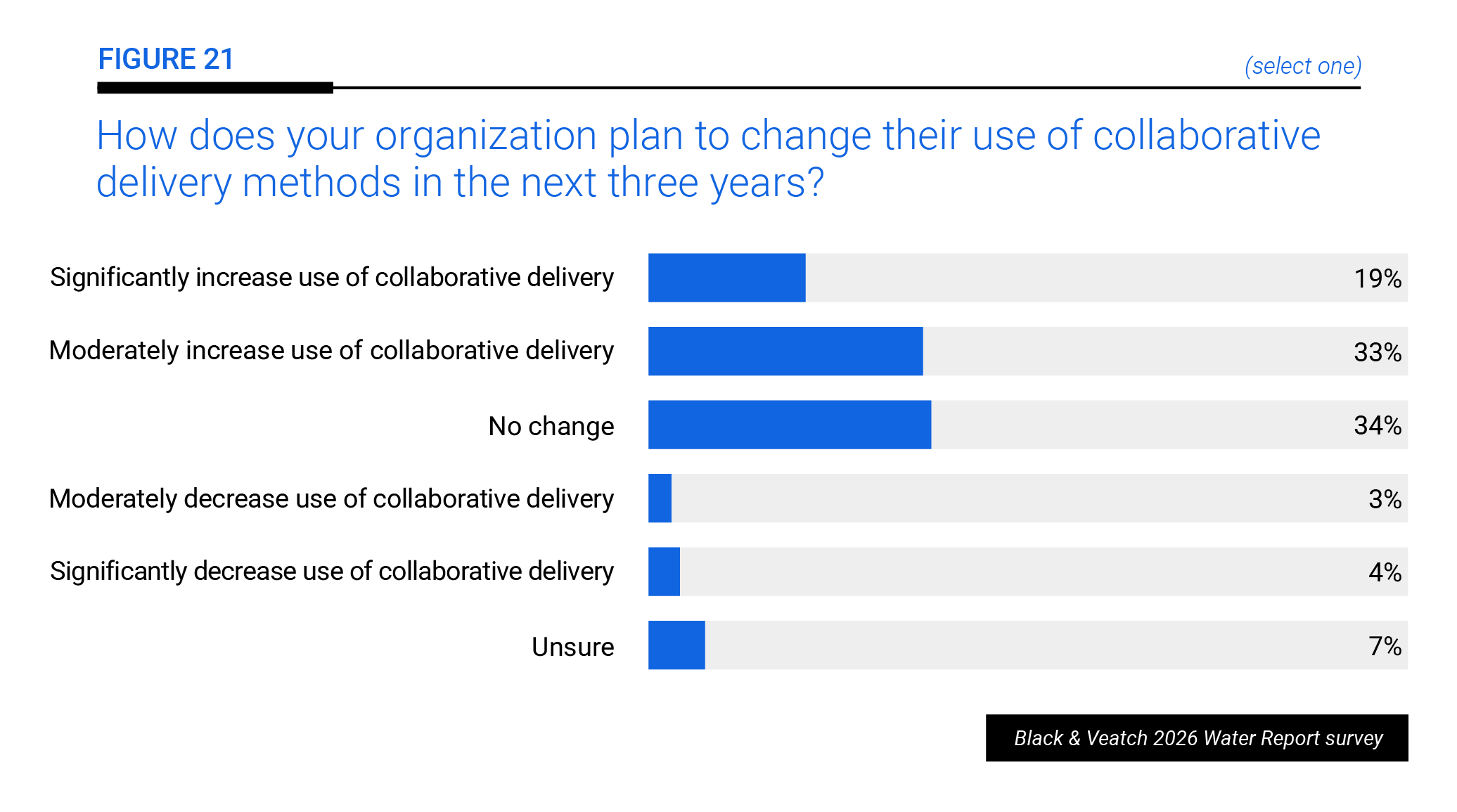
While keeping traditional design-bid-build delivery in the mix, utilities are building a broader toolkit and applying each method where it performs best. The challenge ahead is to develop the internal capability to use each one well.
Collaborative delivery is increasingly used for good reason
On complex projects, under real schedule pressure, collaborative delivery methods manage risk earlier and deliver more predictable outcomes. Utilities that get the most from it are ready, D, training staff, engaging stakeholders early and being candid about the projects and teams that are prepared for a more collaborative way of working.
The tools are proven. The market is established. What remains is the human work of building capability in design-build, PDB and CMAR, and that work starts inside the organization.